Precision parts
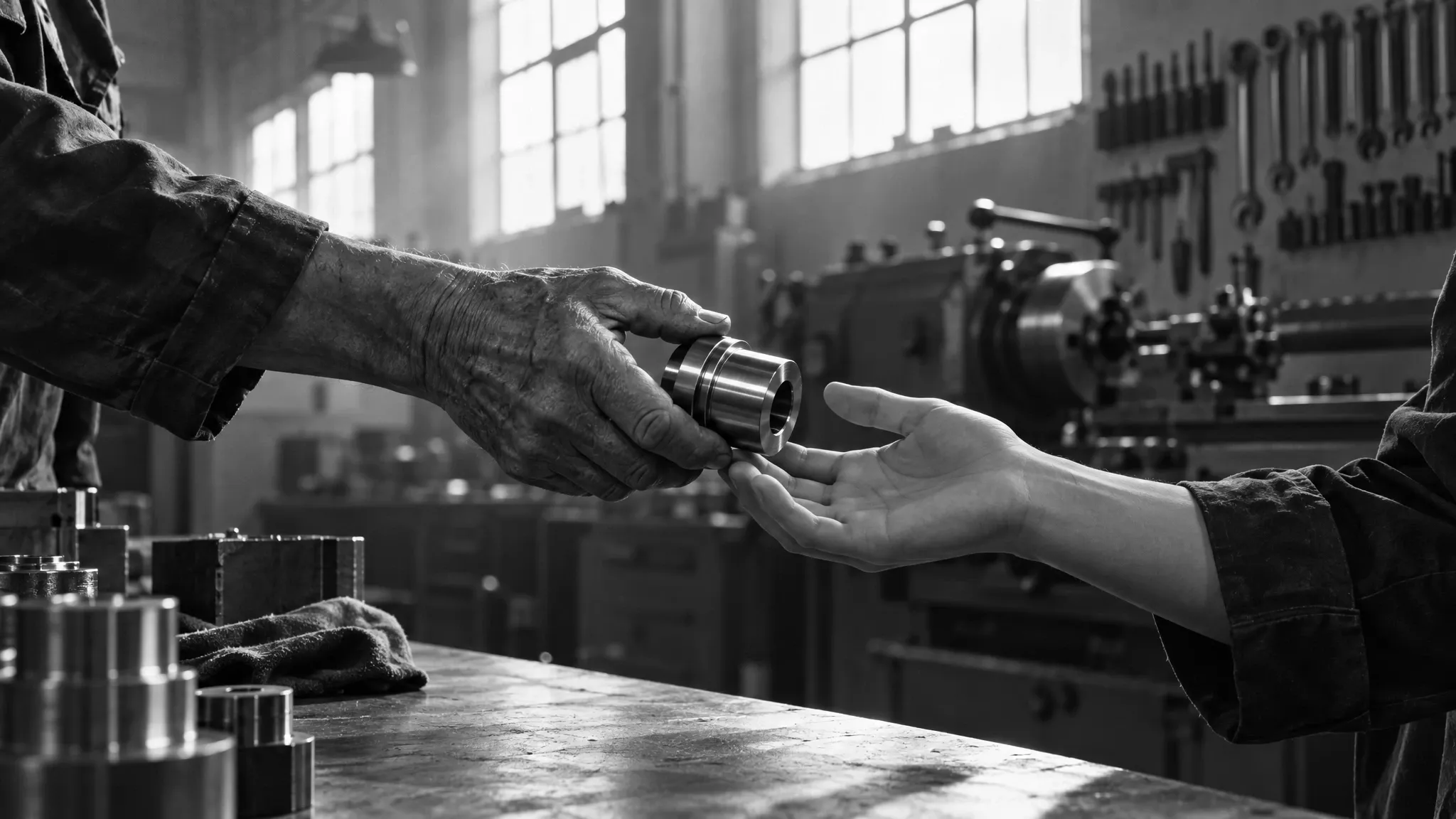
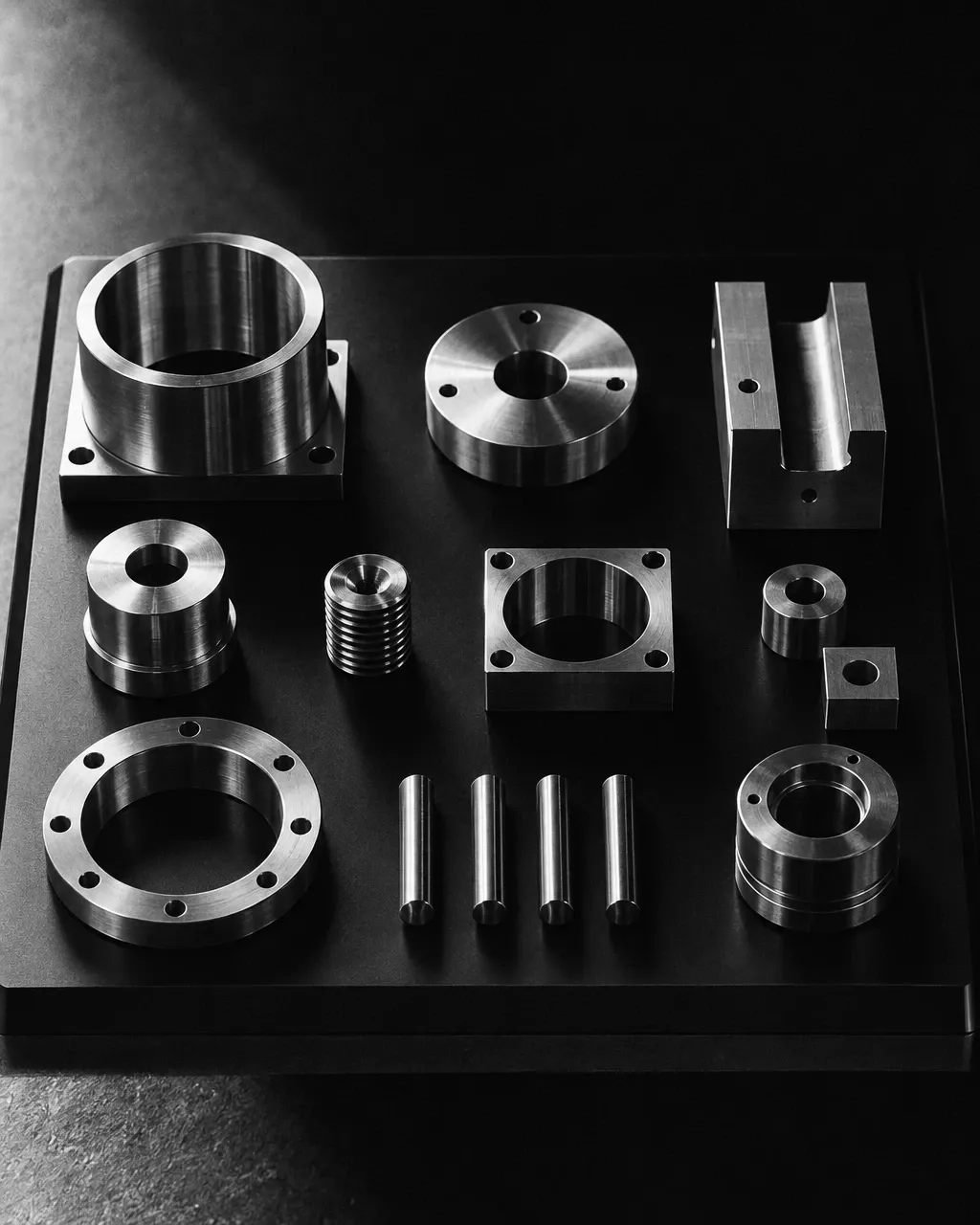
Machining, moulds and components supplying Korea’s auto, electronics and shipbuilding chains.
Owners of well-run Korean companies rarely advertise a sale. We act for those owners, so the companies we introduce are actually for sale, and we show you which numbers have been checked against documents.
No commitment. Two lines about what you have in mind is enough.
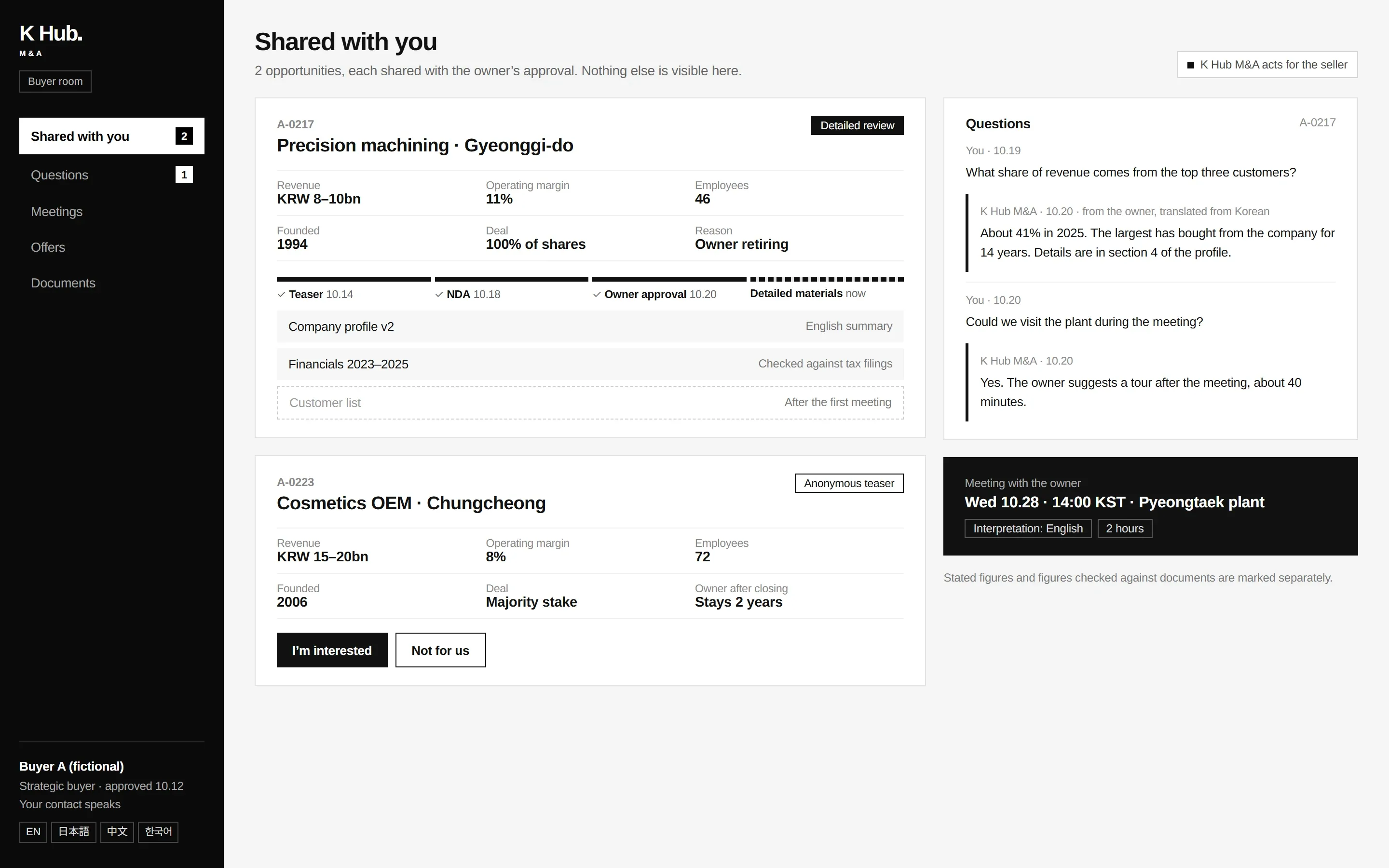
We act for the sellers. Every company we introduce has an owner who has decided to sell and has engaged us to run the process.
Figures confirmed against tax filings and documents are marked separately from figures the owner has told us.
Filings, site visits, owner meetings and the seller’s Korean advisers are coordinated by our team in Seoul.
We work across industries. These are areas where Korea’s smaller companies are especially strong.
Machining, moulds and components supplying Korea’s auto, electronics and shipbuilding chains.

Cosmetics OEM and ODM makers, and brands with export channels already running.

Sauces, fermented and processed food, with factories, certifications and retail listings in place.

B2B software and IT service companies with customers who keep coming back.

Medical device makers, distributors and clinic services.

Wholesale, distribution and logistics firms with established routes and accounts.
Typical deal value: KRW 1–10 billion (roughly USD 0.7–7 million).
Korea’s economy runs on small and mid-sized companies, and many of the people who founded them are now in their sixties and seventies.
of Korean companies are SMEs
Ministry of SMEs and Startups, 2023
of people working at Korean companies work at SMEs
Ministry of SMEs and Startups, 2023
of SME owners surveyed are 60 or older
Korea Federation of SMEs, 2025 succession survey of 600 SMEs
of them have completed a succession
Korea Federation of SMEs, 2025 succession survey of 600 SMEs
Figures as published by each source.
Many of these companies have a factory, a brand and customers they have kept for decades. Their owners want a buyer who will keep the staff, the customers and the know-how. For you, that is a business with a long record that is still trading, often with a founder willing to stay on for the handover.
We don’t send out lists of companies for sale. When a company matches what you told us and its owner agrees, we introduce it to you.
On the deals we introduce, K Hub M&A acts for the seller. That is why owners trust us with their companies. We will explain everything clearly, but your investment decision and your own advisers stay yours.
Want us to search on your behalf instead? K Hub Partners takes on buy-side mandates under a separate agreement, where there is no conflict with a seller we represent.
Industry, size, structure and timing. A short note or a 30-minute call is enough to start.
Who is buying, why, and how the deal would be funded. Stated budgets and verified funds are recorded separately.
When a company fits, we send a summary without its name.
After an NDA and the owner’s approval, you see the company name and detailed materials in the buyer room.
We arrange meetings and the site visit, and interpret where needed. Questions go through the buyer room.
Due diligence, offer, contracts, foreign investment filing and closing, one step at a time.
None of these should hold up a deal, as long as they come up early.
Buying 10% or more of a Korean company for KRW 100 million or more usually counts as foreign direct investment. It is reported to a foreign exchange bank or KOTRA before the money is sent. In most industries it is a filing, not an approval.
Defence, broadcasting and telecoms, finance, and companies holding designated national core technologies need extra approval or review. We flag this at the teaser stage.
Many smaller Korean companies are not required to have an external audit. We separate figures confirmed from documents from those the owner has told us.
Once you and related parties hold more than 50%, Korean local tax can treat you as acquiring the company’s taxable assets, such as real estate and vehicles (the deemed acquisition tax). Have your tax adviser size it early.
In many SMEs, relationships with customers, banks and staff run through the founder. A transition period and the owner’s role after closing are part of the negotiation.
Bank loans often carry the owner’s personal guarantee or collateral. Replacing them is usually a condition of closing.
General information, not legal or tax advice. Rules change, and each deal is confirmed with qualified advisers.
Seoul shares a time zone with Tokyo and is one hour ahead of Beijing, Shanghai, Taipei and Hong Kong. Most of North-East Asia is a short flight away, so a site visit fits into two days.
Singapore
Your time --:--
Point at a city.
Flight times are typical scheduled times from Seoul, rounded to the half hour.
Our team includes members with English-speaking, Japanese and Chinese backgrounds who work alongside our Korean dealmakers. They are on your deal from the first call, so you never have to explain things twice.
Calls, teasers, questions and meeting notes in English.
Japanese-speaking members handle calls, summaries and meetings with owners.
Chinese-speaking members do the same, from the first call to the owner’s table.
With the owner we speak Korean, and we come along when you visit the factory.
Accountants, tax advisers, lawyers, and labour and finance specialists work with K Hub M&A as one team for the seller. The companies we bring you have their numbers in order, and likely issues have already been looked at.
In most industries, yes. A small number of sectors limit foreign ownership or need prior approval. We check this for each opportunity.
Not necessarily. Foreign companies and individuals can acquire shares directly after the foreign investment filing. Some buyers prefer a Korean holding company for tax or financing reasons; your advisers can compare the options.
No. Owners trust us because their companies are not on a public list. We share opportunities that match your criteria, one at a time, with the owner’s approval.
On the deals we introduce, we act for the seller. For a buy-side search, K Hub Partners can take you on under a separate agreement where there is no conflict.
Mostly deal values of KRW 1–10 billion (roughly USD 0.7–7 million). Tell us if you are looking for something larger or smaller.
English, Japanese, Chinese and Korean, for calls, emails, documents and meetings with owners. The contract language is agreed for each deal.
Tell us what kind of company you have in mind. A short note is enough to start.
Prefer email?contact@khpts.com